Over the past few weeks, the conversation around data centers in space has reached an inflection point. Some of the world’s most influential leaders in technology and aerospace have publicly declared that the next great computing frontier is no longer on Earth. It is above it.
At Satlyt, this moment represents validation of what we have been building since day one: a software-first network that transforms satellites into virtual data centers in orbit.
Artificial intelligence has pushed terrestrial infrastructure to its limits. Power constraints, cooling requirements, and land scarcity are forcing a rethink of where compute happens. Space provides a simple but revolutionary alternative with limitless solar energy, near-continuous exposure to sunlight, and natural radiative cooling in the vacuum of orbit. The advantages are not theoretical anymore. They are being acted on by the biggest players in the world.
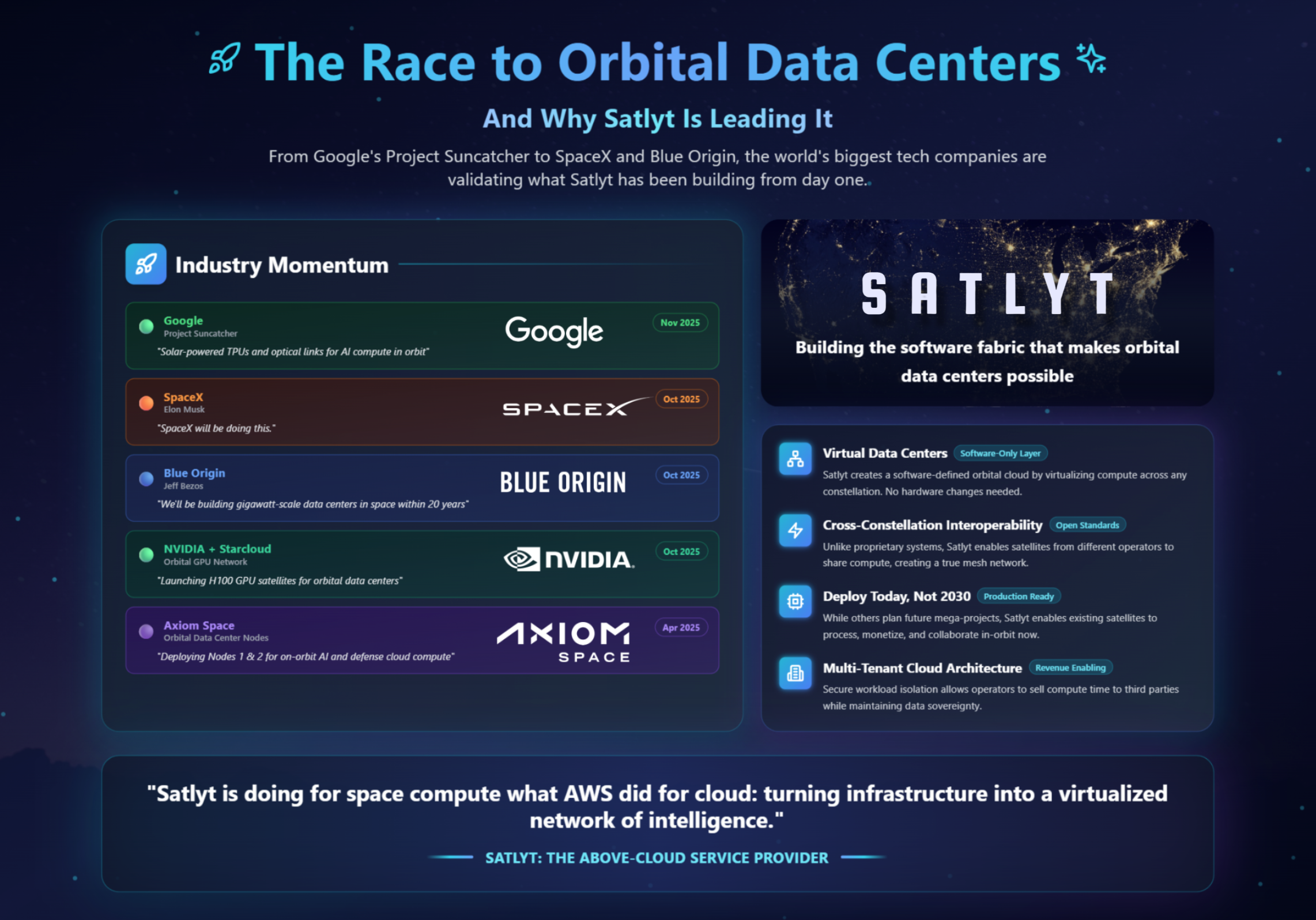
Jeff Bezos, founder of Amazon and Blue Origin, said during Italian Tech Week 2025 that gigawatt-scale orbital data centers will be “the next step for space ventures that make Earth better.” Elon Musk, in a statement to Ars Technica, confirmed that “SpaceX will be doing this,” suggesting that future Starlink V3 satellites could be scaled into orbital data center architectures. Google, through its new research initiative Project Suncatcher, unveiled a moonshot to deploy constellations of solar-powered satellites equipped with TPUs and free-space optical links to scale AI compute directly in orbit. Axiom Space announced that its first Orbital Data Center nodes will launch to low-Earth orbit, enabling secure, high-speed AI and ML processing for national security, commercial, and scientific customers. And most notably, NVIDIA has already taken a major step toward making orbital compute a reality. Using Starcloud as the launch vehicle, NVIDIA’s first data center-class H100 GPUs have been successfully deployed in orbit. This marks the first time an advanced AI accelerator has operated beyond Earth, proving that large-scale machine learning and inference workloads can be performed in space.
These developments are not isolated experiments. They signal the start of a structural transformation in computing as energy, AI, and space infrastructure converge.
While the giants are preparing to build the hardware of orbital data centers, Satlyt is already building the software fabric that will connect them. Satlyt’s platform creates virtual data centers by turning satellites into interoperable, containerized compute nodes. Through our software-only inter-satellite network, spacecraft can share resources, run AI models in orbit, and process data where it is collected, drastically reducing latency, energy cost, and dependency on ground stations.
Our architecture is intentionally distributed. Instead of waiting for gigawatt-scale monoliths, we are enabling thousands of existing satellites to collaborate as a unified computing mesh, a “cloud above the clouds.” With partnerships spanning hardware providers, space agencies, and energy innovators, Satlyt is bridging the gap between today’s orbital capabilities and tomorrow’s data center economy.
For years, Satlyt’s vision that space would become the next compute layer was considered ambitious. Now, it is becoming consensus. Google’s Project Suncatcher demonstrates that solar-powered AI constellations are viable. SpaceX’s Starlink V3 architecture hints at a scalable orbital communications backbone. Axiom Space’s ODC program underscores the demand for secure, low-latency in-orbit compute. NVIDIA and Starcloud’s successful deployment of H100 GPUs proves that state-of-the-art AI hardware can survive and perform in orbit. Together, these efforts confirm that orbital compute is not just a concept. It is an inevitable evolution.
As data generation accelerates, particularly from Earth observation and satellite IoT networks, the need for edge computing in orbit becomes critical. Processing terabytes of imagery, telemetry, and sensor data before downlinking it to Earth saves bandwidth, reduces latency, and improves responsiveness for everything from climate monitoring to autonomous systems. At the same time, terrestrial data centers face mounting scrutiny over carbon emissions and energy use. Space offers clean, continuous power, a natural next step in humanity’s digital and environmental journey.
Satlyt is positioned at the intersection of these forces: sustainability, AI, and space infrastructure. Our mission is simple but transformative.
To build the distributed software layer that powers the next generation of space infrastructure.
While others prepare to construct the massive hardware of tomorrow, Satlyt enables today’s satellites to act as a cohesive, intelligent network. We are creating a world where compute happens closer to the data source, in orbit, reducing latency, improving resilience, and advancing global digital sovereignty.
This is not the end of cloud computing. It is the next evolution of it. The world’s biggest companies are now racing to build orbital data centers. Satlyt is already there, building the network that will connect them all.
🚀 Satlyt — The Above-Cloud Service Provider™ Learn more at www.www.satlyt.xyz