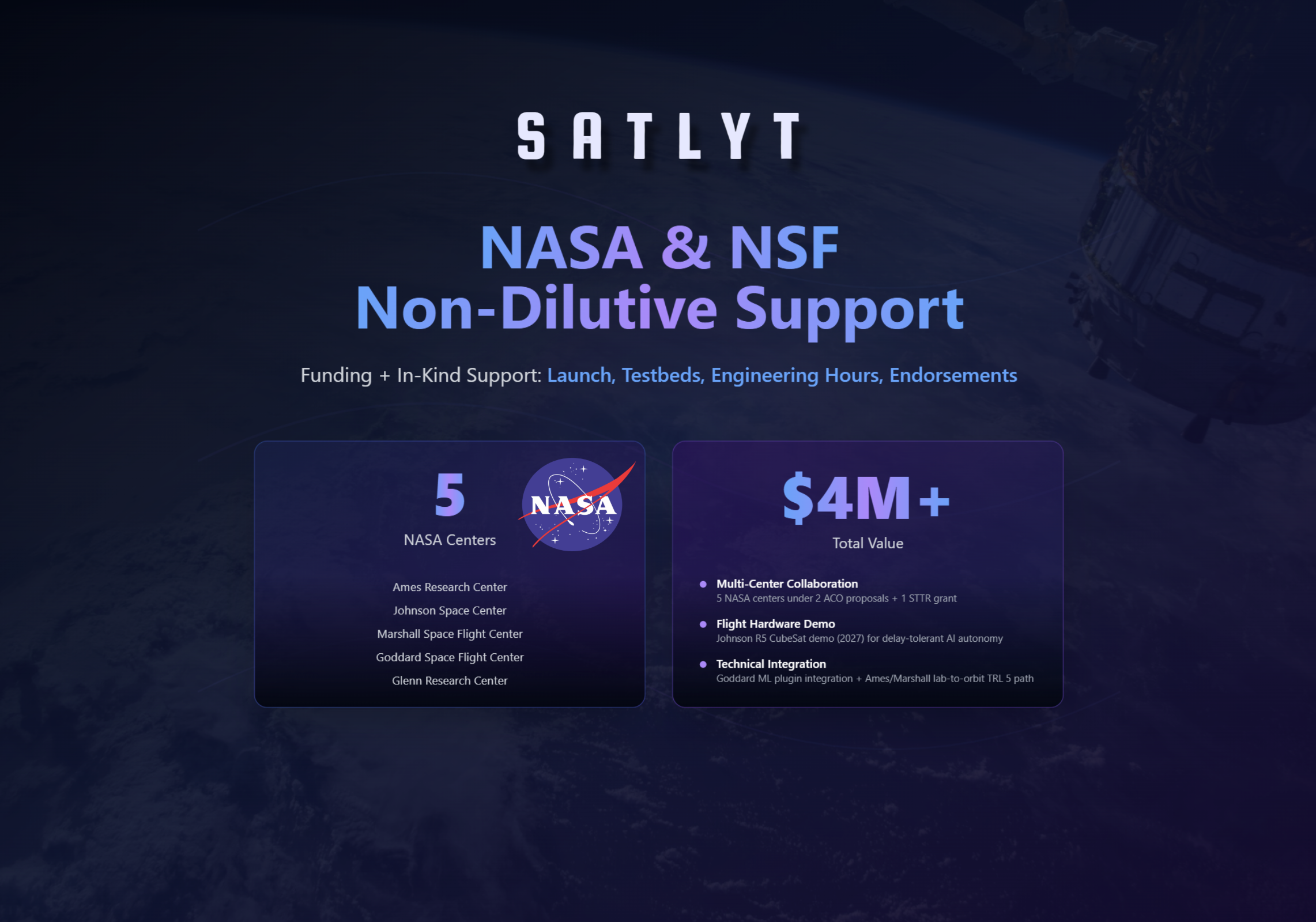
We’re thrilled to share that Satlyt has been selected to partner with NASA across multiple centers under the Space Technology Mission Directorate’s (STMD) 2025 Announcement of Collaboration Opportunity (ACO). In addition, we’ve officially launched our NASA STTR Phase I award in collaboration with NASA Glenn Research Center.
These partnerships represent major technical and commercial milestones for Satlyt’s edge autonomy platform and build directly on our mission to enable intelligent, low-latency computing for small spacecraft in disconnected environments.
Overview of NASA ACO Collaborations
As part of the 2025 ACO cycle, Satlyt is participating in two competitively selected proposals:
- Topic 2: AI-Augmented autoNGC for Edge Autonomy
Partner Center: Goddard Space Flight Center (GSFC)
We are integrating our lightweight anomaly detection and data prioritization software with Goddard’s autonomous Guidance, Navigation, and Control (autoNGC) flight system. The work will enhance onboard decision-making and reduce downlink loads through smart compression and edge-based pre-processing.
- Topic 3: Autonomous Edge Computing for Small Spacecraft Networks
Coordinating Center: Ames Research Center (ARC) Participating Centers: Johnson Space Center (JSC), Marshall Space Flight Center (MSFC)
This cross-center demonstration will showcase our secure containerized edge autonomy stack across three NASA testbeds. Ames will lead integration in the OSE-SAT and DSA platforms. Johnson will support an on-orbit flight demonstration via its R5 CubeSat. Marshall will provide delay-tolerant networking simulation and autonomous quality-of-service validation through its HOSC and DTN cloud infrastructure.
Across these engagements, NASA will contribute a combined $3 million in civil service support to help advance the technology from TRL 3 to TRL 5.
NASA STTR Award and GRC Collaboration
In parallel with the ACO work, Satlyt was selected as one of only 47 startups nationally for the NASA Small Business Technology Transfer (STTR) Phase I award, valued at $150,000 We are now working closely with NASA Glenn Research Center to design delay-tolerant mobile edge cloud protocols and to lay the groundwork for a follow-on Phase II award of $850,000.
The STTR program allows us to build foundational software infrastructure in partnership with top NASA researchers while keeping our development tightly aligned with operational needs across future missions.
Looking Ahead
Satlyt’s growing collaboration with NASA is a strong endorsement of our edge computing architecture and its potential to reshape how spacecraft process and respond to data. With support from ARC, GSFC, JSC, MSFC, and GRC, we’re creating a scalable, modular solution for autonomous operations in space.
These efforts will help de-risk commercial and science missions alike, especially those operating far from Earth, across intermittent links, or in harsh environments like cislunar orbit or lunar night.
We’re proud to be working at the intersection of AI, autonomy, and space systems—and grateful to NASA for the partnership and trust.
Onward.