Satlyt has officially become space-faring.
In March 2026, we executed two missions that moved us from concept to deployment. We uplinked software to a live satellite with Rogue Space, and we deployed AI-driven systems on a Momentus spacecraft through a DPhi Space mission.
These were not demos. They were real systems running in orbit.
STL-01 / Genesis Signal was our first successful uplink of Satlyt software onto a Rogue Space satellite. We deployed a lightweight Python-based system of about 26KB over highly constrained links, down to roughly 20 KB/s, and executed it in orbit.
This validated core capabilities. We can deploy software to spacecraft we do not own, run managed services in orbit, and begin to support a bring-your-own-satellite compute model.
Onboard, the system handled telemetry ingestion, compression and storage, early anomaly detection, and downlink prioritization. The key outcome was simple. Software ran in orbit, reliably.
Space infrastructure has traditionally been static. Software is fixed before launch, updates are limited, and onboard compute is underused. This mission showed that software can be deployed and operated dynamically in orbit.
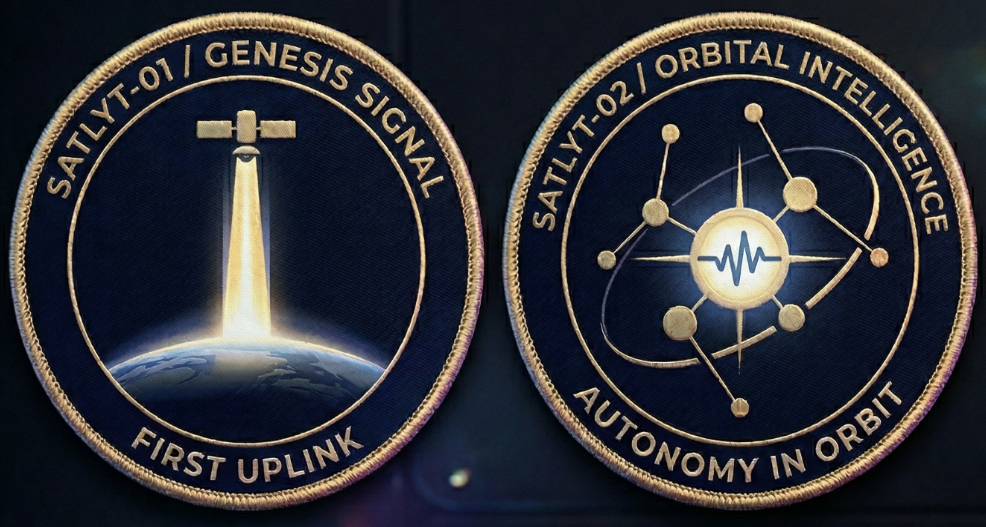
The Genesis Signal patch represents that moment. A single beam connects Earth to a satellite, with a waveform embedded in the beam to reflect software becoming active in space. It marks the first heartbeat of orbital compute.
STL-02 / Orbital Intelligence built directly on that foundation. This mission flew on a Momentus spacecraft via a DPhi Space mission and introduced onboard intelligence.
We deployed an AI troubleshooting agent based on a Gemma small language model, along with edge processing for sensor and imagery data. We also ran synthetic error injection and autonomous diagnostics.
Instead of acting as a passive data pipeline, the system interpreted inputs, responded to conditions, and adapted in real time. This shifts compute closer to where data is generated, reducing reliance on downlink and enabling faster decision-making.
This is the transition from data infrastructure to decision infrastructure.
The Orbital Intelligence patch represents that shift. A distributed network of satellites forms a connected system with a central point of coordination. The structure is dynamic, not static, and the embedded waveform reflects continuous processing and feedback.
We use patches to mark real milestones. They are not branding. They are a record of what has been deployed and proven in orbit.
These first two missions establish the foundation for what comes next. We are building toward systems that can coordinate across satellites, operate autonomously, and remain resilient under real space conditions.
Each step forward is measured the same way. Did it run in orbit. Did it deliver value. Did it move the system forward.
Space is becoming software-defined, networked, and intelligent. These missions are the first steps.