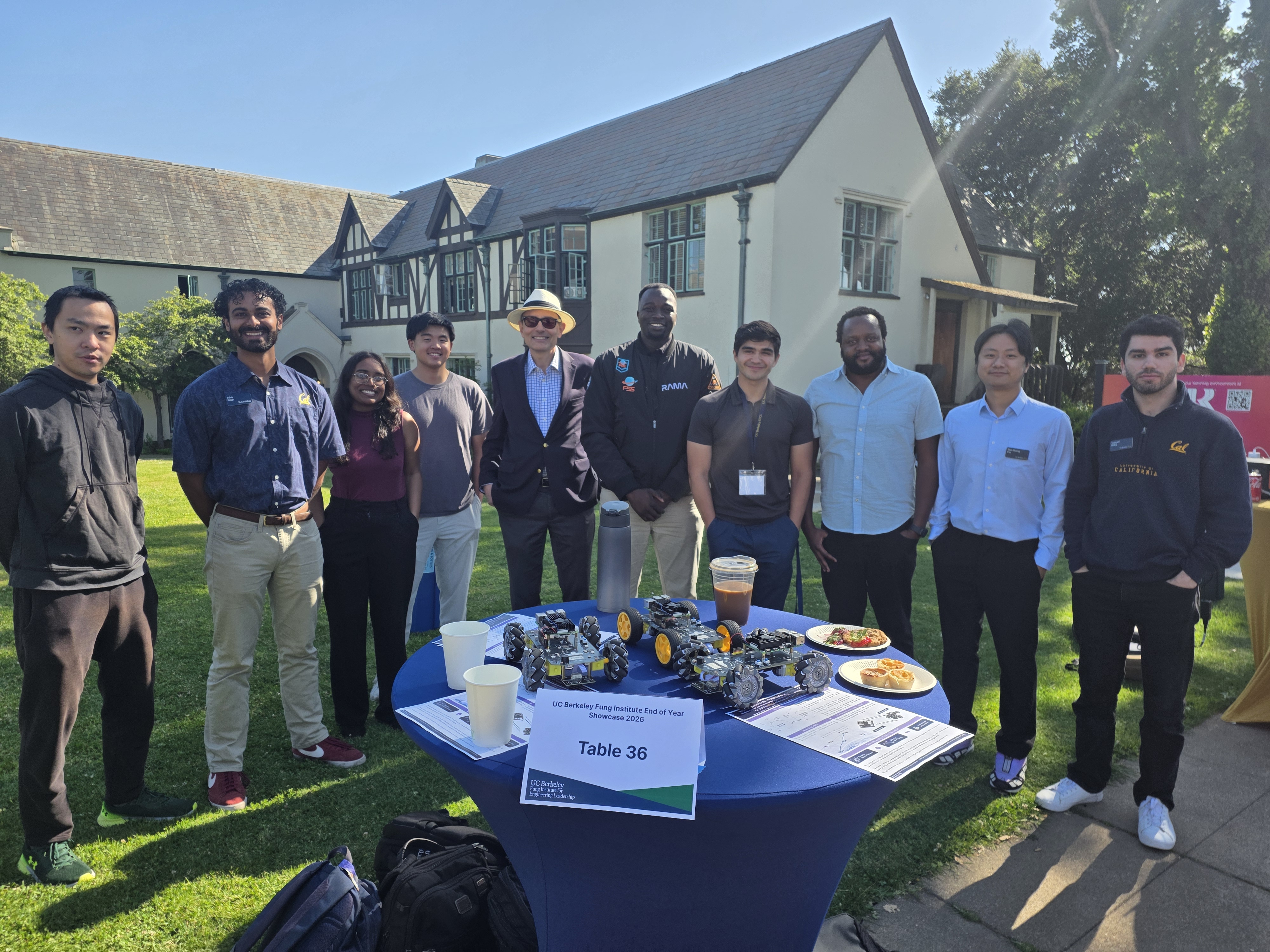
Last week, UC Berkeley published “The Future of Intelligent Satellites”, highlighting two Capstone projects developed in collaboration with Satlyt exploring onboard AI and distributed satellite networking.
Today, the Small Language Models team behind the “Small Language Models as Edge-Orchestrators for Satellite Analysis,” received the Fung Institute MEng Technical Leadership Award at Berkeley’s 2026 Capstone Showcase.
Over the past year, students across the SLM and Hardware-in-the-Loop (HIL) teams explored how satellites can process information locally, coordinate autonomously, and make decisions directly in orbit under constrained compute, bandwidth, and latency conditions.
The SLM team, led by Nathan McNaughton, Youssef Miled, and Tian Herng Tan, developed a hybrid architecture where compact language models act as orchestration layers for tools such as anomaly detection, telemetry analysis, and log summarization.
Alongside them, the HIL team, led by Shreya Sinha, Sahil Singh, Lanny Tseng, and Mike Lin, built a robotic networking testbed capable of simulating realistic orbital communication environments including packet loss, intermittent connectivity, and dynamic routing conditions.
Together, the projects reinforced a growing thesis inside Satlyt:
Future satellite networks will require Foundational Small Language Models for Satellites, compact distributed AI systems purpose-built for orbital environments rather than adapted from terrestrial cloud infrastructure.
The collaboration was supported by UC Berkeley Faculty Advisor Prof. Panayiotis Papadopoulos, Satlyt CTO Nelson Kigen Psenjen, and project leads Leina Meoli and Junn Hope Wangari, who coordinated day-to-day technical execution across both teams.
Satlyt and UC Berkeley are now exploring additional collaborations beyond the Capstone program, including NASA STTR opportunities focused on autonomous in-space operational systems and distributed orbital computing. Satlyt is also preparing a new Berkeley Capstone project for the 2026–2027 academic year centered around autonomous edge intelligence for satellite networks.
As the industry shifts toward orbital data centers, onboard AI, and distributed satellite compute, the line between spacecraft and computing infrastructure is beginning to disappear.
For Satlyt, that future is already being prototyped.